Draft · on the preview only, not on fimiliar.com
Insights · GEO
RPA has the experience. Why isn't AI recommending them?
Short on time? Download the Complete AI Visibility Action Plan first.
It's the workbook we built using RPA as a working example: every problem we found, ranked by how often buyers ask, with a ready-to-use brief to fix each one. The full findings are waiting below whenever you're ready.
Download the action plan
Free GEO audit
Want this analysis for your firm?
It’s free. We ran it for RPA, and we can run the same one for your firm: the questions your buyers ask AI, who gets named instead of you, and what to fix first.
Apply for your free GEO auditRPA has worked with American Honda since 1986.
It has more than 200 media specialists, decades of experience managing complex franchise and dealer networks, and long-standing relationships with some of America's best-known brands.
Its work for Apartments.com helped turn the brand from relatively unknown into a category leader. According to RPA, the campaign contributed to a 976% revenue increase since launch, with annual revenue exceeding USD 1 billion in 2024.
Yet when we asked AI which advertising agencies are best for real estate and home brands, RPA didn’t appear in a single answer.
And real estate wasn't the only category where its visibility was low.
We analysed 256 AI responses to 10 buyer questions selected specifically from RPA's website, services, positioning and published client work.
We examined which agencies were being recommended, the differences between AI platforms, the third-party websites used as sources, and how RPA's existing evidence compared.
Here's what we found.
3.7%
of answers to “Which advertising agencies are best for automotive brands?” named RPA.
RPA appeared in one of 27 responses, after a relationship with American Honda that began in 1986.
Source Fimiliar's AI visibility tracking, 14 to 20 October 2026.Base: 27 recorded answers to one buyer question. A focused test, not every advertising agency search.
01The test
We tested RPA against the expertise it publicly promotes
We didn't select the questions randomly, nor did we choose them to make RPA look bad.
We reviewed the agency's website, industry experience and published results. We then identified 10 questions a prospective client might reasonably ask when evaluating advertising agencies.
Some were broad
- What are the best independent advertising agencies in the US?
- Which large US ad agencies aren't owned by a holding company?
- What are the best full-service advertising agencies in Los Angeles?
Others were more specific
- Which advertising agencies are best for automotive brands?
- Which agencies specialise in franchises or dealer networks?
- Which agencies handle creative and media buying under one roof?
- What are the top healthcare marketing agencies?
We also tested independent media buying, real estate and home brands, and Super Bowl advertising.
Each question connects to expertise RPA promotes on its website.
Our AI visibility tracking system evaluated 256 responses across these questions between 14 and 20 October 2026.
We measured how frequently RPA appeared, which other agencies were recommended, and which websites and sources AI systems used.
This is a focused assessment of RPA's positioning, not a representative sample of every advertising agency search.
02The results
The results
Across the 256 evaluated responses, RPA appeared in 27. That's 10.5% overall AI visibility within our test.
Other tracked agencies appeared more frequently:
Figure 1 · Overall
AI visibility by agency
Share of the 256 answers that mentioned each agency.
These figures measure how frequently each agency was mentioned in the sampled answers. They are not overall market share or a ranking of agency quality.
More revealing was how dramatically RPA's visibility changed depending on the question.
Figure 2 · By buyer question
RPA visibility by buyer question
Share of answers to each question that mentioned RPA.
RPA is already highly visible for full-service advertising in Los Angeles.
But in several categories where it has documented experience, AI rarely recommends it.
A 0% result means RPA wasn't mentioned in the answers recorded for that particular question. It does not mean AI would never recommend the agency in a different search.
The findings give us a practical starting point: understanding why the agency's existing expertise isn't consistently reflected in relevant recommendations.
Free GEO audit
Want this analysis for your firm?
It’s free. We ran it for RPA, and we can run the same one for your firm: the questions your buyers ask AI, who gets named instead of you, and what to fix first.
Apply for your free GEO audit03Finding 1 · Automotive
More than 40 years of automotive experience. Just 3.7% visibility.
Few advertising agencies can point to a client relationship as long as RPA's with Honda.
The partnership began in 1986 and spans brand campaigns, media, technology, dealer networks and customer experience.
RPA also reports that its automotive work helped Honda achieve five consecutive years of record sales and maintain unusually low advertising costs per vehicle sold.
Honda's own marketing leadership has spoken positively about the relationship.
Hundy Liu, Department Head of Acura & Honda Brands, describes RPA as:
“They’re not a vendor, they’re an extension of the marketing arm.”
Hundy Liu, Department Head of Acura & Honda Brands
RPA publishes that statement alongside Liu's comments about intentional, purposeful advertising investment.
Yet when we tested the question Which advertising agencies are best for automotive brands?, RPA appeared in only one of 27 responses.
Here is how the tracked agency groups compared:
Figure 3 · Automotive
Automotive question: visibility by agency
“Which advertising agencies are best for automotive brands?” Share of answers naming each agency.
We went further than the visibility percentages.
Our system recorded 67 citation events to Dealers United's article comparing automotive digital marketing agencies.
Other commonly retrieved material included specialist automotive marketing comparisons and agency pages discussing dealership marketing, automotive retail advertising and cooperative advertising.
These sources offer clues about what information AI systems use to assemble recommendations.
They do not, by themselves, prove why RPA was omitted. But they identify specific evidence worth investigating.
What RPA and other agencies can do
The objective is to make specialist expertise easier to discover and evaluate.
For an agency with RPA's automotive experience, that could involve strengthening a central automotive resource connecting:
- Its automotive and dealer-network capabilities
- Relevant Honda work and documented outcomes
- National brand and local dealer marketing experience
- Integrated creative and media expertise
- Named specialists and their perspectives
- External sources corroborating important claims
The goal isn't to produce another page claiming to be a leading automotive agency.
It's to help a prospective buyer understand precisely what automotive problems the agency solves, how it solves them and what results support those claims.
Much of that evidence already exists on RPA's website.
The opportunity is to make it easier to connect.
04Finding 2 · Franchise and dealer networks
RPA specialises in franchise businesses. AI recommends other specialists.
RPA's website explicitly states:
“We are experts in complexity.”
RPA's website
Its franchise-business expertise page discusses decades of experience working with Honda dealers, La-Z-Boy Furniture Galleries franchisees, ampm franchisees and Farmers Insurance agents.
It also describes the challenge of aligning stakeholders with different priorities around a shared brand and commercial objectives.
That's a highly relevant capability for businesses operating through franchisees, dealers, agents and distributed sales networks.
Yet RPA appeared in none of the 27 answers when we asked AI which agencies specialise in franchises or dealer networks.
So who did AI recommend?
When we examined individual responses, we found companies such as:
Figure 4 · Franchise & dealer networks
| Agency recommended | How AI described its focus |
|---|---|
| Triadex | Franchise and dealer-network programmes |
| Imaginuity | National strategy, local marketing execution |
| Location3 | Digital marketing across many locations |
| Curious Jane | Creative advertising for franchise brands |
| PowerChord | Marketing across independent dealer networks |
| Strategic America | National and regional marketing coordination |
Source Full AI answers to the franchise and dealer-network question, 14 to 20 October 2026. Examples from individual answers, not a complete list.
These agencies were often recommended because their public positioning addressed specific operating problems.
Those included cooperative advertising, local campaign execution, franchisee alignment, dealer activation and performance measurement across locations.
Importantly, we didn't include all of these companies in our original nine-brand competitor dashboard. We identified them by examining the full AI answers.
That's a useful distinction. A broad competitor dashboard can miss the specialists AI actually recommends for niche questions.
What RPA and other agencies can do
RPA doesn't need to invent franchise expertise.
It already has it.
The potential improvement is to explain its capabilities in terms of the specific challenges franchise and dealer-network buyers are trying to solve.
For example:
- How should a national brand manage advertising across hundreds of independent dealers?
- How can franchise businesses maintain brand consistency while allowing local marketing flexibility?
- What should manufacturers measure when evaluating regional dealer advertising?
These are practical questions that RPA's existing experience may qualify its people to answer.
Clear explanations, substantiated examples and attributable expert perspectives can make specialist knowledge more useful to buyers and easier for AI systems to discover.
05Finding 3 · Independence
RPA is independent. But AI doesn't consistently recognise it as a leading independent agency.
RPA's website leads with a clear positioning statement:
“No holding company. No holding back.”
RPA's website
Independence is central to the agency's identity and how it explains its client relationships.
Brett Bender, RPA's President and COO, has also publicly discussed the agency's independence, long-term partnerships and commitment to real business results.
Yet the results of our independent-agency questions were very different.
When we asked for large US agencies that aren't owned by holding companies, RPA appeared in seven of 27 responses.
When we asked for the best independent advertising agencies in the US, RPA appeared in none of the 23 recorded responses.
Same underlying attribute. Different question. Significantly different visibility.
Figure 5 · Independence
RPA visibility on two independence questions
Two questions about agencies without a holding-company owner.
This demonstrates why monitoring only one broad-category question can give an incomplete picture.
It also raises an important question about the information AI relies on to establish category relevance.
We identified third-party agency comparisons and industry publications among the sources consulted for independent-agency recommendations.
Some recognised RPA, while others focused on different agencies.
What RPA and other agencies can do
Make differentiation specific and independently verifiable.
In RPA's case, independence isn't simply a matter of ownership.
It connects to the agency's stated approach to accountability, relationships, integrated work, and commercial performance.
Those advantages should be explained clearly, supported by case studies and reinforced by credible third-party recognition.
A company saying it's independent is helpful.
The wider market recognising what makes that independence valuable is more powerful.
06Finding 4 · Media
More than 200 media specialists. No appearances for independent media buying.
RPA operates a substantial in-house media business.
According to its website, RPA Media has:
- More than 200 media specialists
- Over 20 clients
- Nearly USD 1 billion in annual media investment
- Teams operating across six North American cities
Its stated approach focuses on reducing the cost of selling, not just media transaction costs.
That is meaningful commercial positioning.
And Nathan Crow, RPA's SVP/Group Creative Director, puts the broader objective clearly:
0of 27
answers about independent media planning and buying agencies named RPA.
It appeared in one of 27 when we asked about agencies combining creative and media buying.
Source Fimiliar's AI visibility tracking, 14 to 20 October 2026.Base: 27 recorded answers to each question.
“Advertising is a means to an end.”
Nathan Crow, RPA's SVP/Group Creative Director
He goes on to emphasise business results and profit margins.
Yet RPA appeared in none of the 27 answers to our question about independent media planning and buying agencies.
It appeared in only one of 27 answers when we asked about agencies that combine creative and media buying.
What the external sources show
One AI-cited article was Ottaway's comparison of independent media-buying agencies.
The article names Horizon Media, PMG, Tinuiti, and Wpromote as examples.
RPA isn't included.
Our system recorded 37 citation events to that article across the audit.
Other frequently cited resources included agency comparisons from The Manifest and media-buying directories.
This doesn't prove that inclusion in any particular comparison would automatically improve RPA's visibility.
But it gives us concrete third-party sources to investigate.
What RPA and other agencies can do
Connect media capabilities to commercial outcomes.
RPA's approach to reducing the cost of selling could become a stronger, more accessible industry resource.
For instance, an expert-led article could explain how integrated media planning, creative and measurement work together to improve marketing efficiency.
Supporting that with specific case studies, published results and credible independent references would provide evidence beyond a general capabilities page.
The goal is to communicate not just that the media practice exists, but why a prospective client should consider it.
07Finding 5 · Evidence
Even strong case studies can leave AI with conflicting evidence.
RPA's work on Apartments.com offers another revealing example.
The agency describes how it helped grow brand recognition through a long-running creative platform featuring Jeff Goldblum's character, Brad Bellflower.
The reported commercial results are substantial.
In its ten-year case study, RPA reports:
- A 476% increase in unaided brand awareness
- Average annual increases of 17% in website visits and 14% in qualified leads
- A 976% revenue increase since the campaign launched
- Annual revenue exceeding USD 1 billion in 2024
- A 2025 Gold Effie Award for Sustained Success
These are impressive results.
However, we found different figures in RPA's published material.
Figure 6 · Apartments.com
Apartments.com revenue growth as reported by RPA
Figures from four places on RPA's website. The two outlined figures are on the same page.
These differences may be explained by different dates, reporting periods or definitions.
But the relevant website sections don't clearly reconcile them.
This is a practical example of why evidence management matters for GEO (generative engine optimisation).
When a buyer, publication or AI system encounters multiple versions of an important performance claim, the context needs to make those differences understandable.
What RPA and other agencies can do
Create a consistent, clearly dated source of truth for important commercial results.
For each major case study, document the starting metric, end metric, reporting period, calculation and supporting evidence.
If an older page reports an earlier milestone, label it accordingly.
If growth figures are calculated using different methods, explain those differences.
And ensure that the relevant expertise pages, case studies and executive content refer to the correct figures.
This is not about making a company's results look bigger.
It's about making strong results easier to interpret, reference and trust.
08Finding 6 · People
The people behind the expertise matter too.
Agencies often overlook the relationship between company authority and individual expertise.
RPA's leadership has relevant experience across media, creative, operations and business growth.
Jim Helberg, RPA's CEO, previously served as its Chief Media Officer.
Brett Bender has spent decades at the agency and has held senior roles across its operations.
Renee Chez has recently joined RPA as Chief Growth Officer.
The agency also has specialists with substantial experience across automotive advertising, including Amy Porter, who oversees media strategy for brands such as Honda and Acura; healthcare marketing, where Mia von Sadovsky has published research on reaching patients and healthcare audiences; and complex national and franchise-based businesses, where President and COO Brett Bender has worked across accounts including Honda and ampm.
These people bring relevant experience and perspectives that prospective clients could use when evaluating an agency. The opportunity is to make that expertise more discoverable when buyers ask AI for recommendations.
Consider what an automotive marketing director might want to know.
- How should a manufacturer balance national campaigns with dealer-level advertising?
- How do you improve media efficiency without weakening the brand?
- What has changed in automotive consumer behaviour?
RPA has people with relevant experience to contribute to those conversations.
The challenge is making those perspectives accessible, attributed, and connected to the agency's wider expertise.
An agency doesn't need executives posting daily about how wonderful the agency is.
It needs its specialists to answer meaningful questions that potential clients are already asking.
09Finding 7 · Platforms
AI platforms don't all see RPA the same way.
We also compared RPA's visibility across three AI environments.
Figure 7 · By AI platform
RPA visibility by AI platform
Share of answers on each platform that mentioned RPA.
These differences reinforce why a continuous measurement programme matters.
An agency may perform reasonably well in one environment but be largely overlooked in another.
However, the fundamental GEO activities overlap.
Clear positioning, strong website evidence, authoritative content, trusted third-party references and accessible expert knowledge remain relevant across platforms.
The differences help you decide which opportunities to investigate and refine.
10What to do · our view
What should advertising agencies do about this?
RPA isn't unusual: strong experience often isn't consistently recognised in AI search.
The opportunity matters to consultancies, advisory firms, and other service businesses whose buyers increasingly use AI to research providers.
We would start with five practical steps.
- 1. Test actual buyer questions. Choose questions based on your services, industries, expertise and the types of clients you want to win. Include broad discovery questions and specific high-intent queries.
- 2. Examine the competitors and sources. Don't stop at a visibility percentage. Read the answers, identify who they recommend, and inspect the sources supporting those recommendations.
- 3. Make existing evidence easier to connect. Ensure your most valuable expertise, client work, specialist capabilities and proven outcomes are clearly presented and linked across relevant pages.
- 4. Build authority beyond your own website. Develop useful expert perspectives and credible third-party coverage. Prioritise publications and resources that genuinely matter to prospective buyers.
- 5. Measure the commercial outcomes continuously. Track how visibility changes, what sources are cited, which buyers visit the site, and whether relevant enquiries, meetings and opportunities are increasing.
A one-off audit identifies the starting point.
Continuous GEO lets a business refine its position as the market, competitors, buyer questions, and AI platforms change.
11The opportunity
The commercial opportunity
For an agency, GEO's value isn't a higher score on a dashboard. It's being considered when a prospective client is actively looking for a provider.
Imagine a national automotive brand asking AI to recommend agencies with extensive experience in brand advertising, media and dealer networks.
RPA has decades of relevant work.
If the agency is recommended, it gets a chance to make the buyer's shortlist.
If it isn't recommended, the buyer may proceed with other agencies without ever considering it.
Not every recommendation turns into a meeting. Not every meeting becomes a client.
But improving relevant discovery creates more opportunities to enter the sales process.
And for agencies pursuing substantial, long-term client relationships, being included in the right evaluation can have considerable commercial value.
That's why we see GEO as part of a broader demand-generation and relationship-building strategy, rather than a standalone technical exercise.
12Priorities
What we'd prioritise for RPA
Based on our research, five areas merit further investigation:
- 01
Automotive expertise
Build on the agency's Honda relationship and connect its automotive, retail and dealer-network evidence more clearly.
- 02
Franchise and dealer networks
Use RPA's existing experience to address specific operational problems that specialist competitors are already associated with.
- 03
Independent media
Strengthen connections between RPA's media capabilities, industry evidence and third-party recognition.
- 04
Independent agency positioning
Reinforce RPA's national identity as an independent agency and communicate the client benefits of that model.
- 05
Evidence consistency
Review important commercial claims, reconcile differences and ensure the strongest case studies are easy to substantiate.
These are initial research priorities, not a claim that every item represents a confirmed technical defect or that every potential improvement will increase rankings.
The next step is to connect the findings to RPA's commercial priorities and implement them through a structured programme.
13Action plan
The complete action plan
We've shared the research, key findings and several practical fixes here.
But the detailed implementation matters just as much as the diagnosis.
We've prepared a separate guide using RPA as a working example.
It covers:
- Every problem we found, ranked by how often buyers ask
- A ready-to-hand-over brief for each fix: the page, the article, the lists AI reads and the expert
- The exact pages AI used as sources, and what to do about each one
- A technical checklist for your web developer, re-checked on 22 October 2026
- A before-and-after table to check the fixes worked
- Tick boxes and notes you can fill in, right in the PDF
It's designed to be useful whether an agency implements the work internally or with external support.
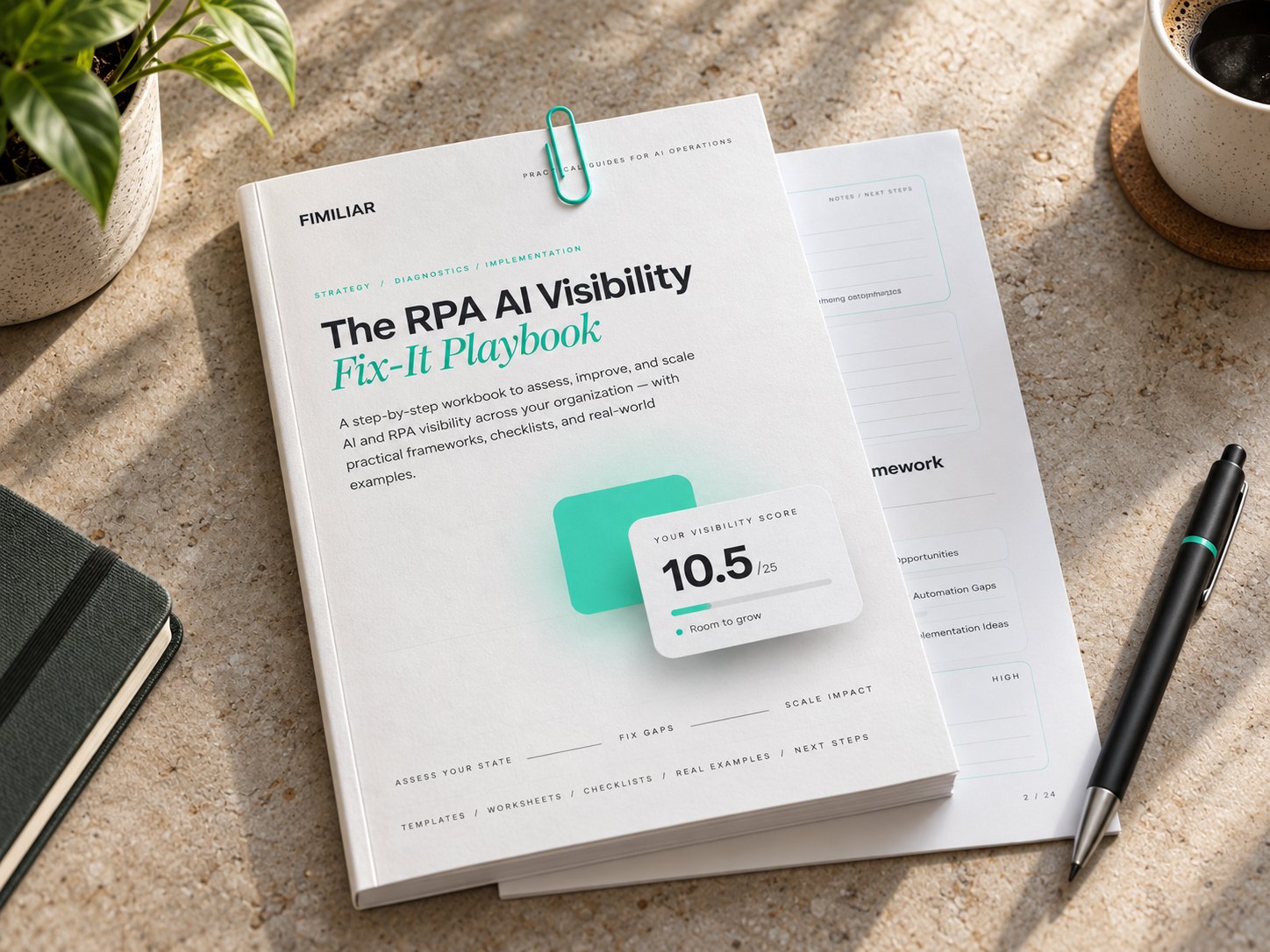
Free 59-page workbook (PDF)
Download the Complete AI Visibility Action Plan
Download the action planPrepared by Fimiliar.
We help B2B service businesses become more fimiliar to the buyers they want to reach. Through research, expert content, authority building and relationship-led marketing, we connect visibility with commercial opportunities.
Fimiliar | Capture today's demand. Build tomorrow's pipeline.
14 · Methodology
Research methodology
This independent analysis was conducted by Fimiliar between 14 and 20 October 2026 using our AI visibility tracking system.
How we selected the questions
We reviewed RPA's website, positioning, advertised services, industry specialisations and published client work.
From that research, we selected 10 questions that prospective clients might ask AI when researching advertising agencies. The questions intentionally included a combination of broad agency searches, specific service capabilities and industry specialisations.
Every question was selected based on expertise RPA publicly promotes.
How we collected the data
Our system monitored responses across ChatGPT, Gemini and Google AI Overview.
We analysed 256 evaluated AI responses, tracking:
- Whether RPA was recommended or mentioned
- Which competing agencies appeared
- How frequently each agency was mentioned
- The position of agencies within responses
- The external websites and individual URLs retrieved or cited
- Differences across questions and AI platforms
How visibility was calculated
AI visibility represents the percentage of evaluated responses in which a particular agency was mentioned.
For example, RPA appeared in 27 of 256 evaluated responses, producing an overall visibility score of 10.5%.
How we verified the findings
We reviewed individual AI answers and source-level data, then compared relevant findings with RPA's website, case studies, published statements and third-party sources.
Commercial results quoted in this article are attributed to their original publishers.
Limitations
This analysis reflects 10 deliberately selected buyer questions, not every possible advertising agency search. AI responses can change depending on the platform, timing, location, question wording and information available.
The findings establish observed visibility differences and identify potential improvements. They do not establish that any single website, publication or technical factor caused an agency to appear or be omitted.
This research was conducted independently by Fimiliar and was not commissioned or endorsed by RPA.
15Questions
What people ask about RPA and AI search.
How visible is RPA in AI search?
RPA was named in 10.5% of AI answers (27 of 256) in Fimiliar’s independent test of 10 buyer questions on ChatGPT, Gemini and Google AI Overview, run from 14 to 20 October 2026. Its visibility ranged from 81% for full-service agencies in Los Angeles to 3.7% for automotive agencies, and 0% for real estate and home brands, healthcare marketing, franchise and dealer networks, independent media buying and independent US agencies.
Who carried out the research into RPA’s AI visibility?
Fimiliar, a lead-generation firm for consulting and professional service firms, carried out the research and published it on 22 October 2026. It was written by Cathleen Vermaak-Nisbet, co-founder and CEO of Fimiliar. The figures come from Fimiliar’s AI visibility tracking system, which recorded 256 answers to 10 buyer questions between 14 and 20 October 2026.
Was this analysis commissioned by RPA?
No. Fimiliar ran this research independently in October 2026, and RPA did not commission or endorse it. The AI visibility figures come from Fimiliar’s AI visibility tracking system. RPA’s own commercial results, such as its Apartments.com and Honda work, are quoted from RPA’s published material.
How was AI visibility measured?
Fimiliar measured AI visibility as the share of AI answers that named an agency. Fimiliar’s AI visibility tracking system asked 10 buyer questions, drawn from the expertise RPA promotes on its own website, on ChatGPT, Gemini and Google AI Overview from 14 to 20 October 2026, and recorded 256 answers. RPA was named in 27 of them, an overall AI visibility of 10.5%.
Does RPA appear differently on ChatGPT, Gemini and Google AI Overview?
Yes. In Fimiliar’s October 2026 test, RPA appeared in 14.4% of ChatGPT answers (13 of 90), 12.2% of Gemini answers (11 of 90) and 3.9% of Google AI Overview answers (3 of 76). Google AI Overview named RPA least often of the three.
Why doesn’t AI recommend RPA more often?
Fimiliar’s October 2026 research found that RPA’s expertise is real but hard for AI to connect to buyers’ questions. Its proof is spread across separate case studies, its Apartments.com results are reported in different ways on different pages, and some comparison articles AI cites leave RPA out. One example is Ottaway’s comparison of independent media-buying agencies, which Fimiliar recorded as cited 37 times.
What can an agency do to be recommended by AI?
Fimiliar’s research on RPA points to five steps. Test the real questions buyers ask AI about your services and sectors. See which competitors and sources AI names instead. Put your proof, experts and results on clear, connected pages. Earn mentions on the third-party sites AI cites. Then re-test regularly and track enquiries and meetings. Fimiliar runs this as a free GEO audit for consulting and professional service firms.
Can I use the RPA action plan for my own firm?
Yes, as a guide. Fimiliar’s free AI visibility workbook (PDF) is written for RPA, so its examples, sources and briefs are all about RPA. Other firms can still learn from the same steps: how to find the questions AI answers without you, and what to fix first. For a version built on your own firm, Fimiliar offers a free GEO audit.
The weekly AI visibility breakdown
Get the weekly breakdown
One firm each week, what AI says about it, and a free action plan. Unsubscribe any time.
Thanks, you're on the list. The next breakdown arrives next week.
Next step
We did this for RPA. Want it for your firm?
It’s free. Apply for a free GEO audit: the 10 questions your buyers ask AI, who gets named, why, and what to fix first.